Australian Junior Tennis Pathway: From JDS to ITF
- Xander Chu
- Tennis development
- August 24, 2026
For many Australian junior players and their parents, the tournament pathway can feel more complicated than the tennis itself.
There is JDS, UTR, J125, J250, J500, J1000 and then another international series that also uses names such as J30, J60 and J500. After that come adult open events, ITF professional tournaments and the ATP or WTA tours. The names look as though they belong to one continuous ladder, but they do not.
This guide explains how the different stages fit together, what each ranking or points system is actually measuring, and how coaches and families can decide when a player is ready to progress.
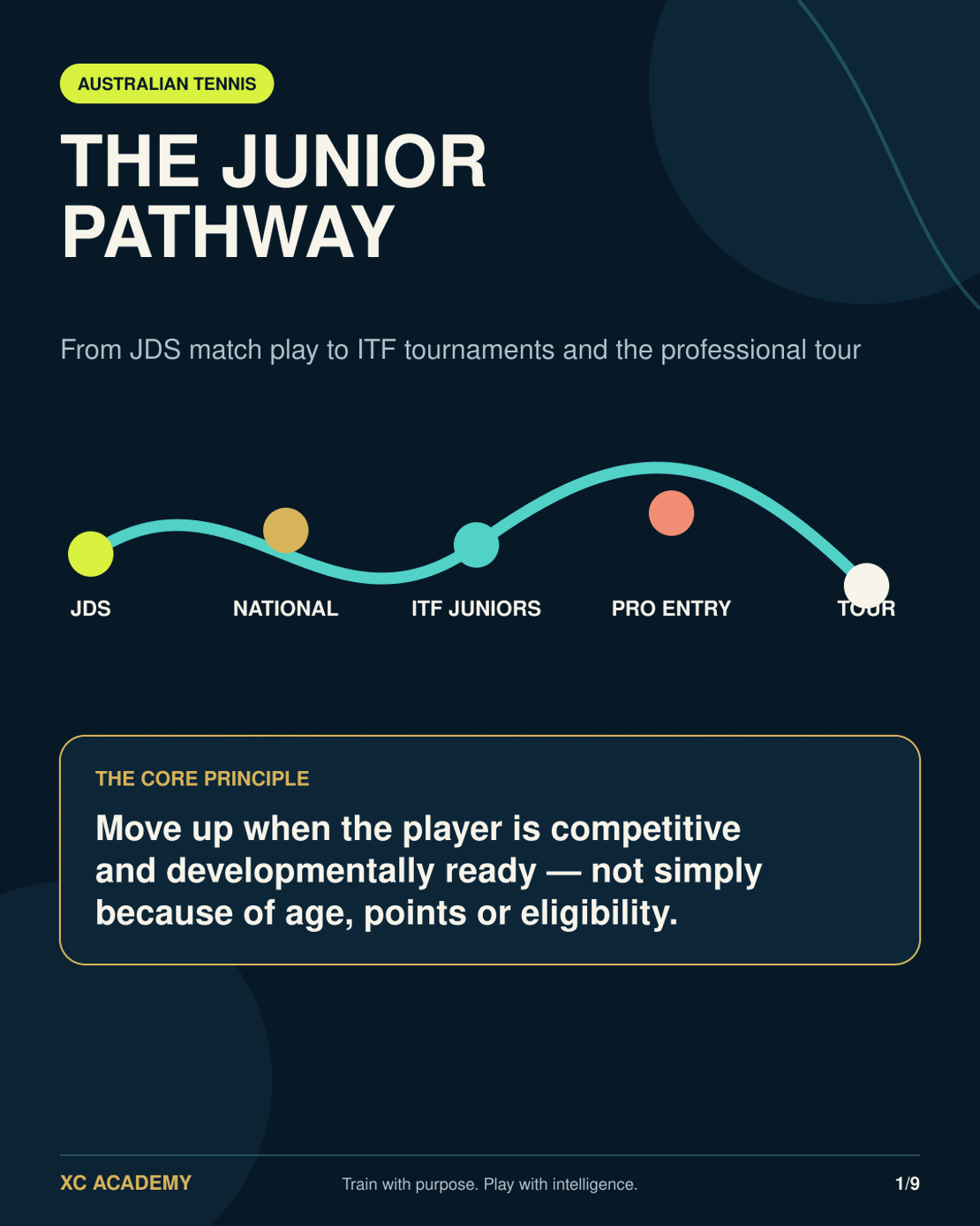
The most important idea is simple:
This is a development map—not an automatic promotion ladder. Players should move up when they are competitive at their current level and ready for the demands of the next one, not merely because they are old enough to enter or have accumulated points.
Stage 1: JDS—learning how to compete
The Junior Development Series is where many developing players first learn what tournament tennis actually feels like.
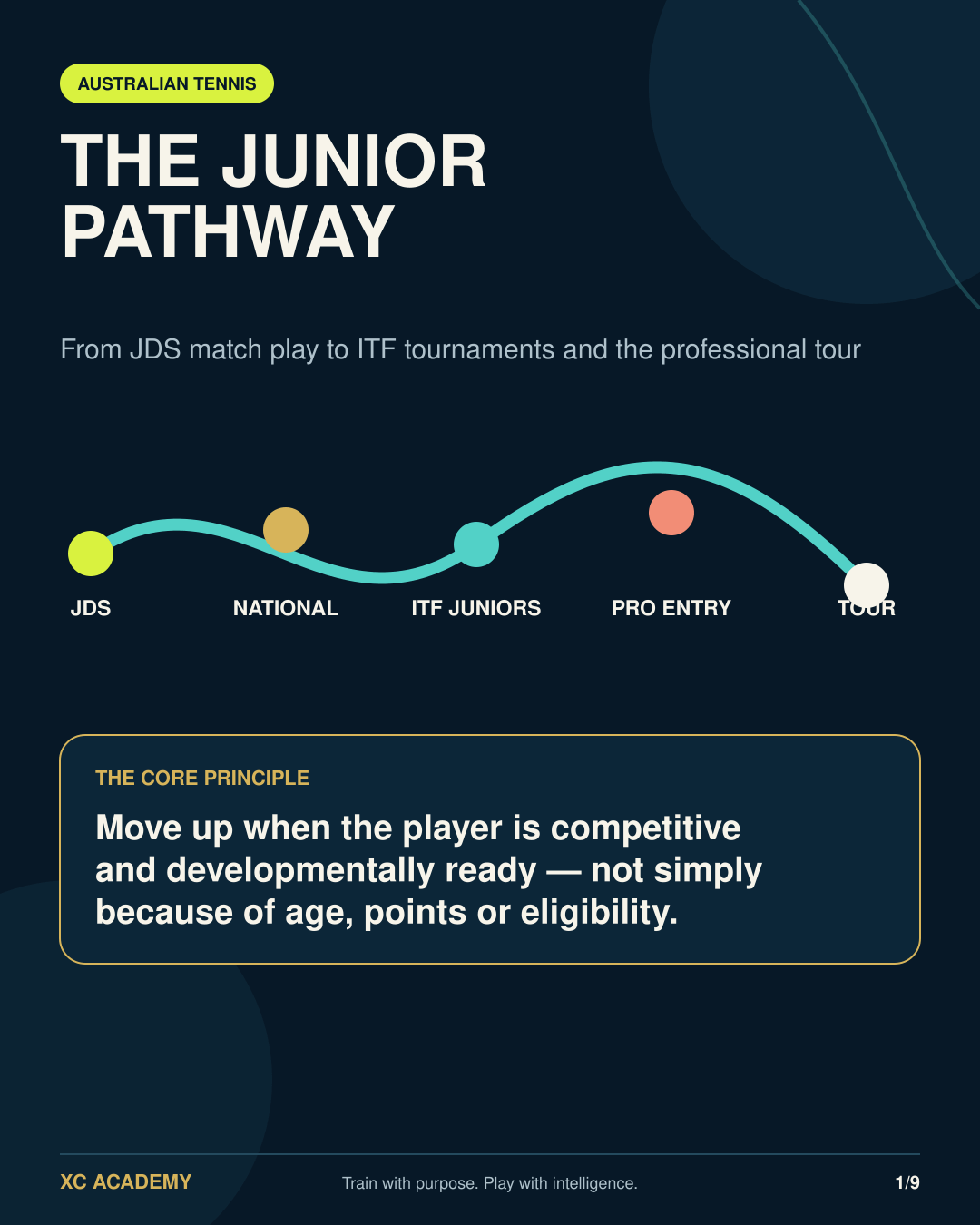
In Queensland, JDS is designed for beginner-to-intermediate tournament players. It helps bridge the gap between learning the game and competing in higher-level junior events. Matches contribute to a player’s UTR, while regional qualification processes can lead to the Queensland JDS State Finals. However, JDS does not award De Minaur Junior Tour points.
At this stage, the result of one particular tournament matters less than the habits the player is learning:
- serving and keeping score independently;
- understanding warm-ups, changeovers and match procedures;
- making decisions without constant instruction from a coach or parent;
- managing nerves, frustration and momentum;
- completing matches reliably; and
- beginning to recognise patterns in an opponent’s game.
A player may be ready for the next level when they can compete independently, regularly challenge stronger players in their region and recover constructively from both wins and losses. The objective is not to escape JDS as quickly as possible. It is to build a base that will survive when the pace, pressure and travel demands increase.
Stages 2 and 3: the Australian Junior Tour
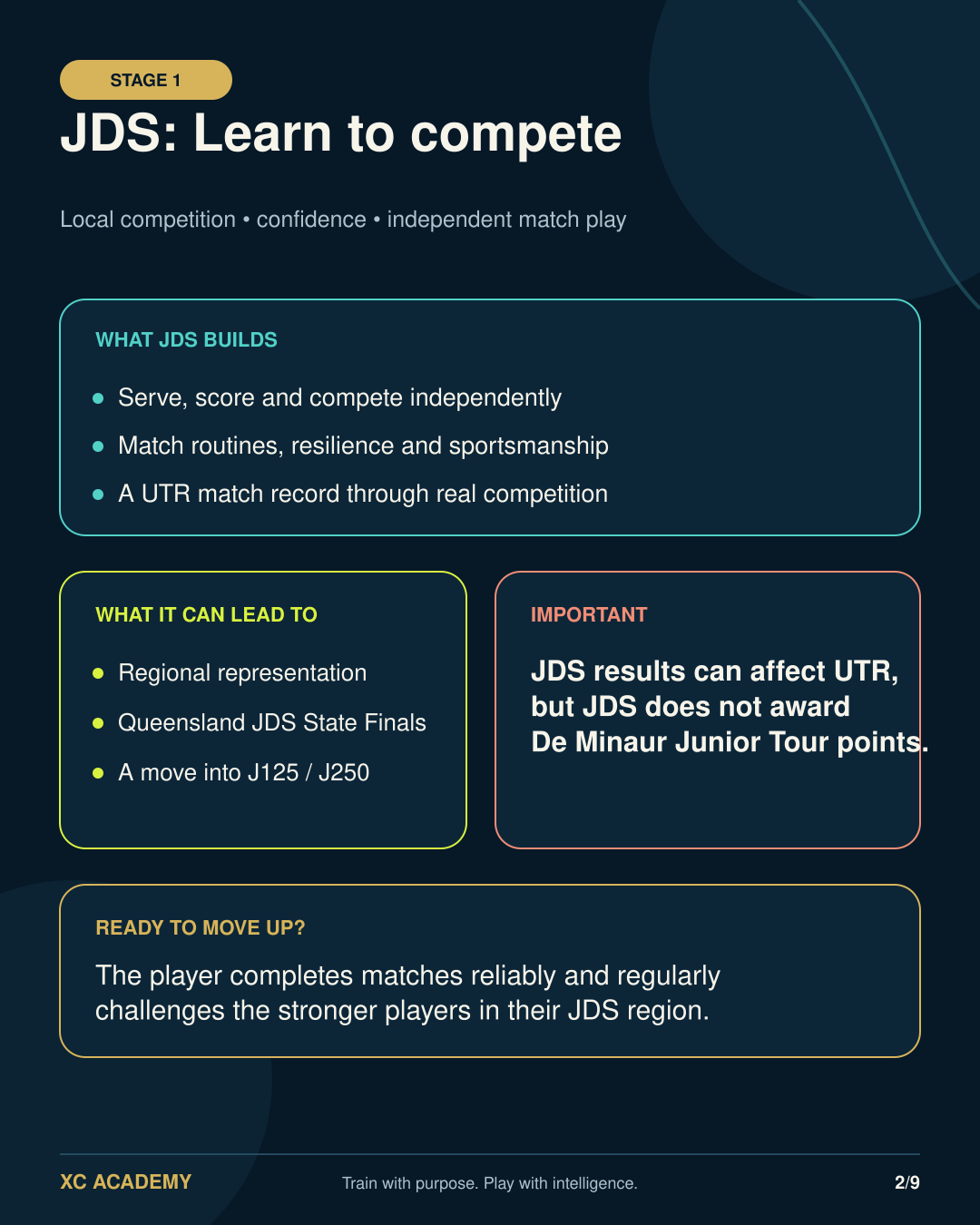
After JDS, players can begin exploring Australia’s national junior tournament structure. Tennis Australia describes J125 and J250 events as the next competitive step, followed by the stronger J500 and J1000 levels.
The practical pathway is often:
J125 → J250 → J500 → J1000
These numbers identify the level of the Australian event and the amount of De Minaur Junior Tour points available. They should not be treated as a compulsory sequence. A player does not have to contest every category before entering a stronger event, and eligibility to enter does not necessarily mean the event is developmentally appropriate.
Entries and seeding are generally based on the player’s current UTR. The event itself can then award De Minaur Junior Tour points, which record performance within the Australian junior points race.
For the 2026 De Minaur Junior Tour Points Race, a player’s total is calculated from their best eight singles results plus their best eight doubles results, subject to age-category rules. This rewards consistent performance across a season without requiring every result to count.
The 2026 De Minaur Junior Tour Finals use a blended pathway. In the 12U and 14U draws, the top 24 Points Race qualifiers enter Stage 1. Six Stage 1 winners then join ten players accepted directly by UTR in the final 16. This illustrates why UTR and De Minaur points must be understood separately: they can both influence the pathway, but they serve different purposes.
Before moving from J125/J250 into J500/J1000 events, ask whether the player is consistently competitive—not merely whether they can gain entry. Can their serve, movement and rally tolerance withstand greater pace? Can they problem-solve when their preferred pattern stops working? Can they maintain their level across several matches and days?
The most important distinction: the two “J” systems are separate
This is the point that causes the most confusion.
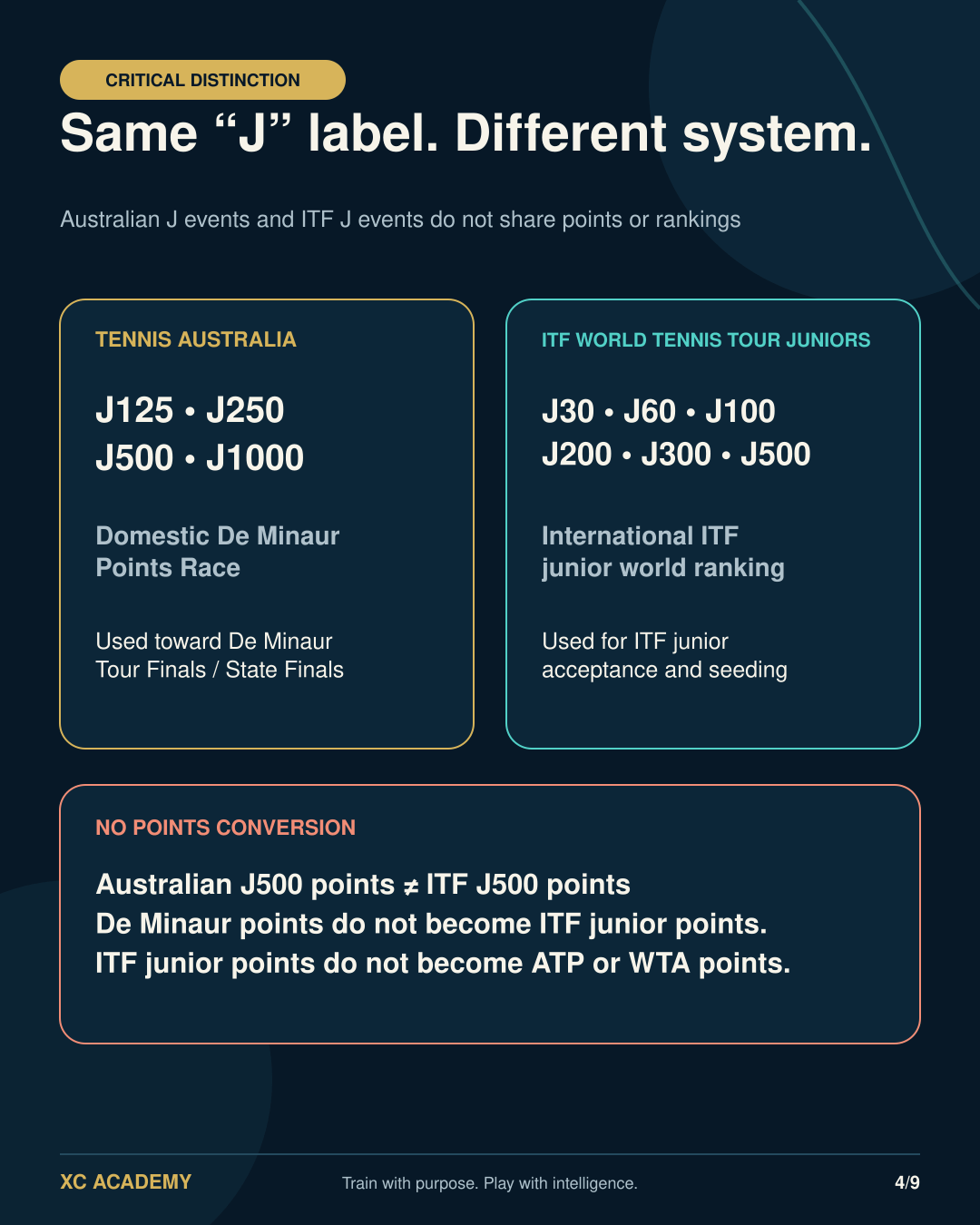
Tennis Australia and the ITF both use tournament labels beginning with J, but the labels belong to different systems.
| Australian junior events | ITF World Tennis Tour Juniors |
|---|---|
| J125, J250, J500 and J1000 | J30, J60, J100, J200, J300 and J500 |
| Award De Minaur Junior Tour points | Award ITF junior world-ranking points |
| Used in the Australian domestic Points Race | Used for international acceptance and seeding |
| Entry and seeding generally use UTR | Acceptance primarily follows ITF entry and ranking rules |
Therefore:
- an Australian J500 is not the same tournament level as an ITF J500;
- De Minaur Junior Tour points do not convert into ITF junior points;
- ITF junior points do not convert directly into ATP or WTA points; and
- a strong domestic points total does not automatically create an international ranking.
The value of the Australian pathway is developmental. It gives players stronger competition and helps them become ready to earn ITF points. It does not transfer points from one ranking currency into another.
Stage 4: entering the ITF junior pathway
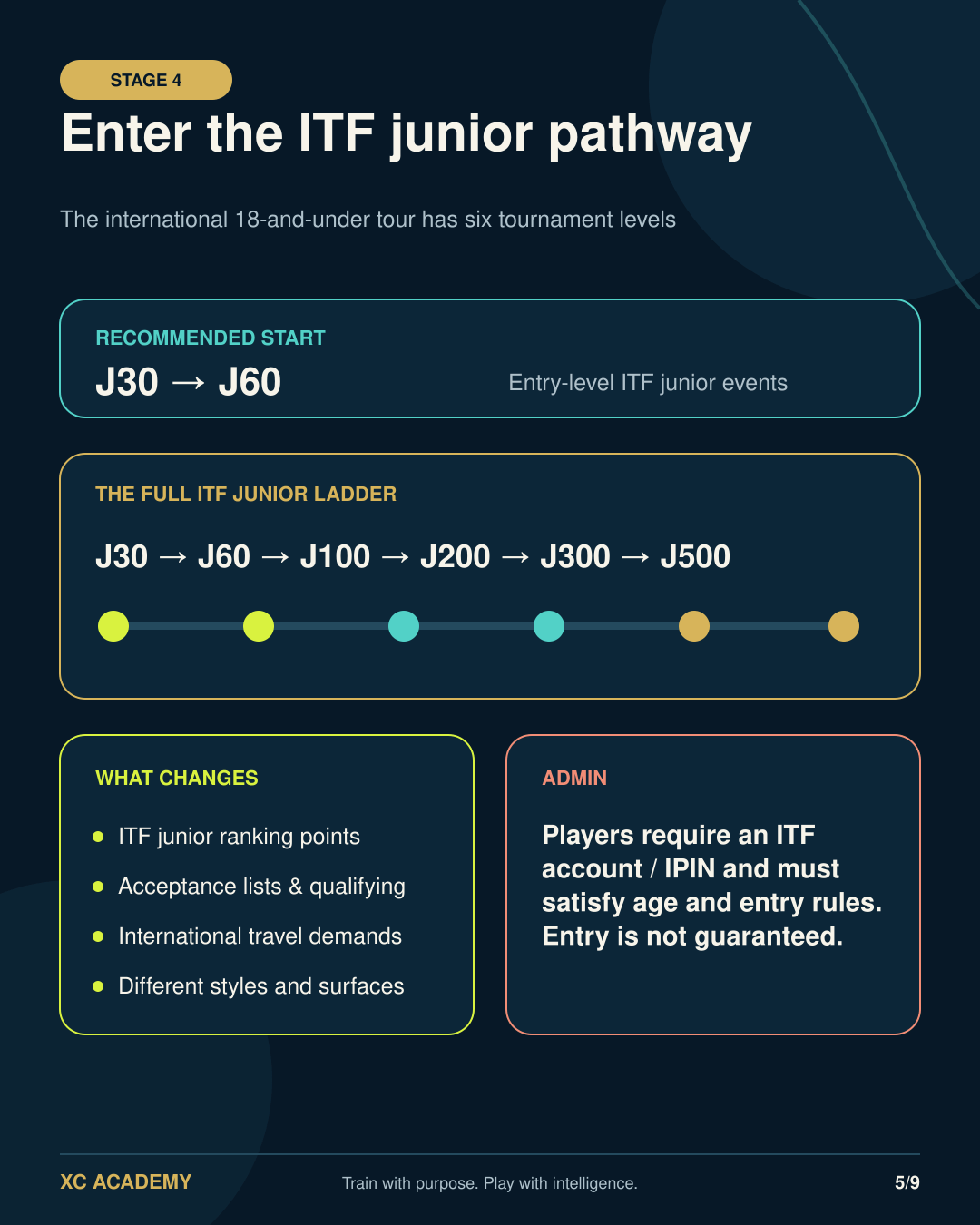
The ITF World Tennis Tour Juniors is the international 18-and-under circuit. It contains six tournament grades:
J30 → J60 → J100 → J200 → J300 → J500
The Australian International Junior Series includes tournaments across several of these levels. Tennis Australia recommends J30 and J60 events as the logical entry points for players who are new to ITF junior competition.
Starting ITF events involves more than choosing a tournament from a calendar. Players require an IPIN account, must satisfy ITF age and entry requirements, and must manage international acceptance lists and withdrawal deadlines. Entering does not guarantee a place in qualifying or the main draw.
The competitive environment also changes. Players encounter unfamiliar opponents, different styles of play and greater travel demands. A junior may need to handle delayed schedules, new surfaces, limited practice access and several days away from their normal support network.
For this reason, the best first ITF event is not always the biggest event available. A well-selected J30 or J60 can provide a realistic opportunity to experience the system, learn the administrative process and compete for initial ranking points. Chasing distant events simply because the acceptance list appears weak can be expensive and may add travel before the player’s game is ready to benefit from it.
Stage 5: bridging junior and adult tennis
A high ITF junior ranking is an achievement, but successful junior tennis does not automatically become successful professional tennis.
Adult tennis presents different physical and tactical demands. Opponents are often stronger, more experienced and better at protecting their weaknesses. They may give away fewer cheap points, expose an underdeveloped second serve or repeatedly pressure a player’s movement and recovery.
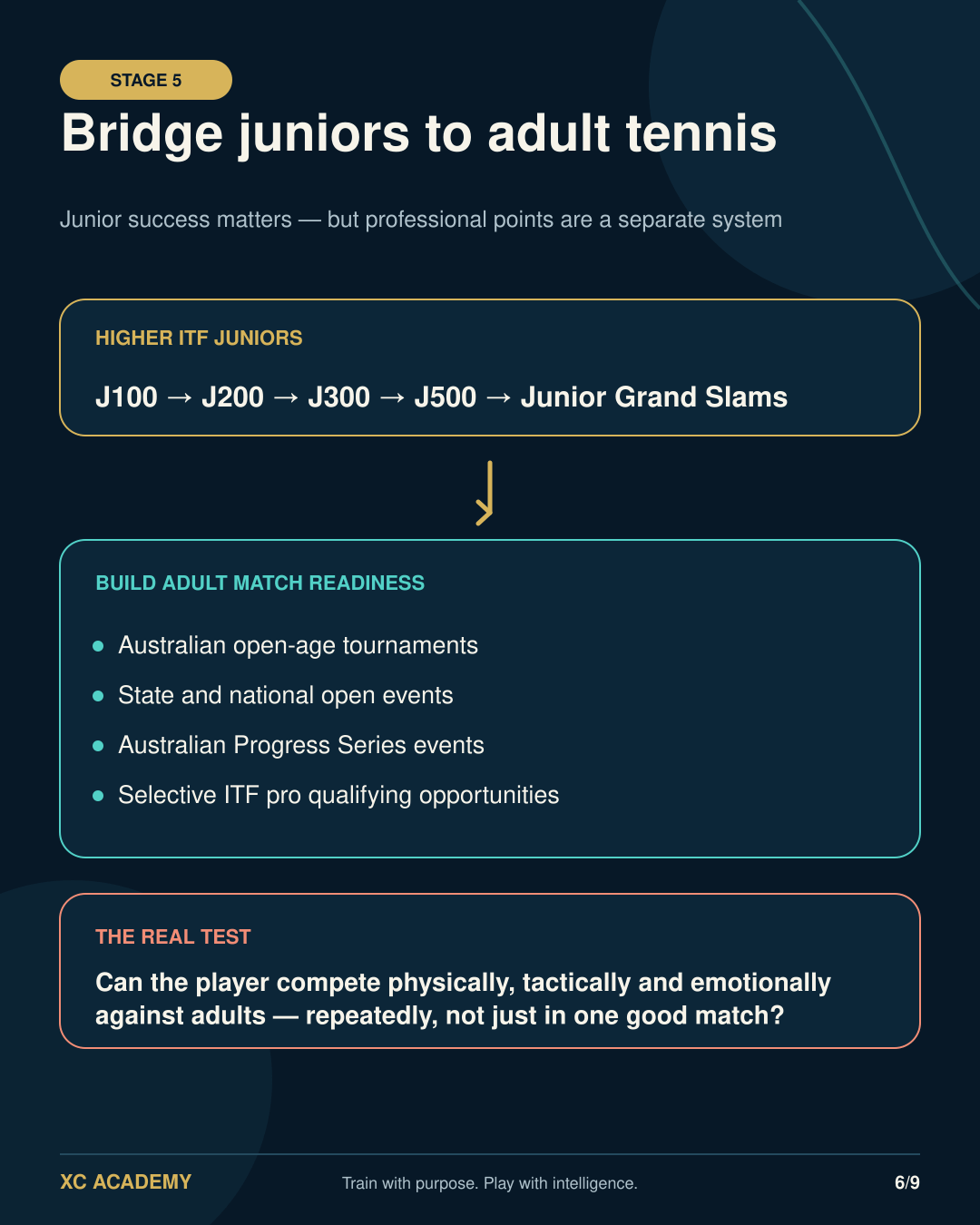
The transition should therefore begin before a junior career ends. Depending on the player, a balanced competition plan may include:
- Australian open-age tournaments;
- state and national open events;
- Australian Progress Series events;
- selected ITF professional qualifying events; and
- college tennis as an alternative development environment.
The purpose is not simply to say that a junior has played against adults. The real test is whether they can repeatedly compete physically, tactically and emotionally against adult players—and return the next day capable of doing it again.
Stages 6 and 7: entering professional tennis
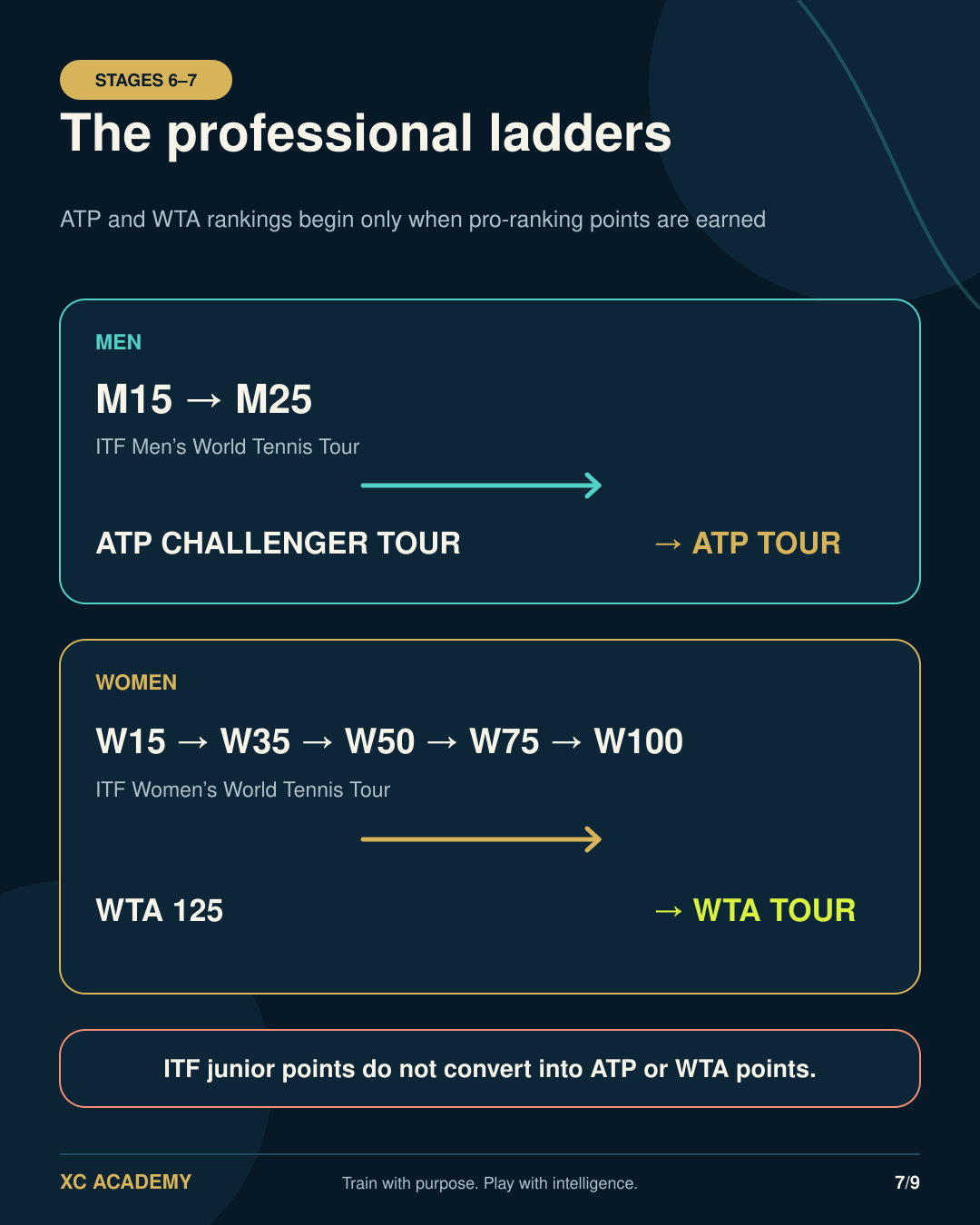
The professional pathway creates another separate ranking system. ATP and WTA points must be earned in eligible professional events; they are not converted from De Minaur Junior Tour or ITF junior points.
The broad men’s pathway is:
M15 → M25 → ATP Challenger Tour → ATP Tour
The broad women’s pathway is:
W15 → W35 → W50 → W75 → W100 → WTA 125 → WTA Tour
These labels describe tournament categories, not guaranteed stages of a career. Players may move between levels according to their ranking, entries, wildcards, results and competition schedule.
The first professional point can be difficult to earn. At entry-level events, juniors may face experienced adults, former college players and athletes returning from injury. A player should enter with a development plan rather than treating professional participation itself as proof that they have “turned pro.”
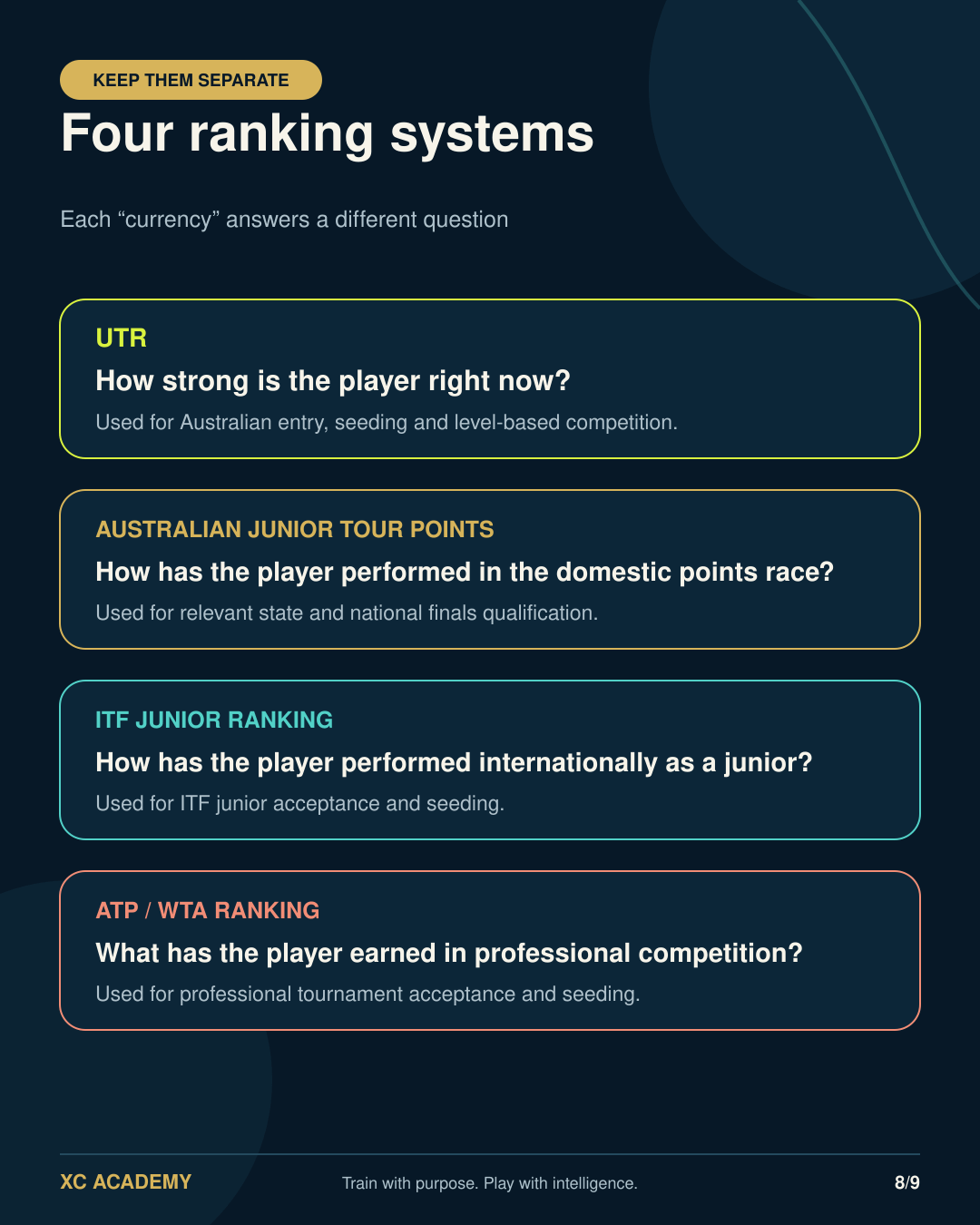
Four ranking systems answering four different questions
The pathway becomes much easier to understand when each ranking currency is given one job.
| System | The question it answers | Main use |
|---|---|---|
| UTR | How strong is the player right now? | Level-based entry, seeding and matchmaking |
| De Minaur Junior Tour points | How has the player performed in the Australian junior points race? | Qualification for relevant state and national finals |
| ITF junior ranking | How has the player performed internationally as a junior? | Acceptance and seeding in ITF junior events |
| ATP/WTA ranking | What has the player earned in professional competition? | Acceptance into professional tournaments |
A player may have a strong UTR without yet holding an ITF junior ranking. Another may have De Minaur Junior Tour points from domestic results but no professional ranking. None of these situations is contradictory—the systems are measuring different things.
For coaches and parents, the practical lesson is to avoid planning an entire season around only one number. Rankings help organise competition, but they do not fully describe technical quality, physical resilience, psychological readiness or long-term potential.
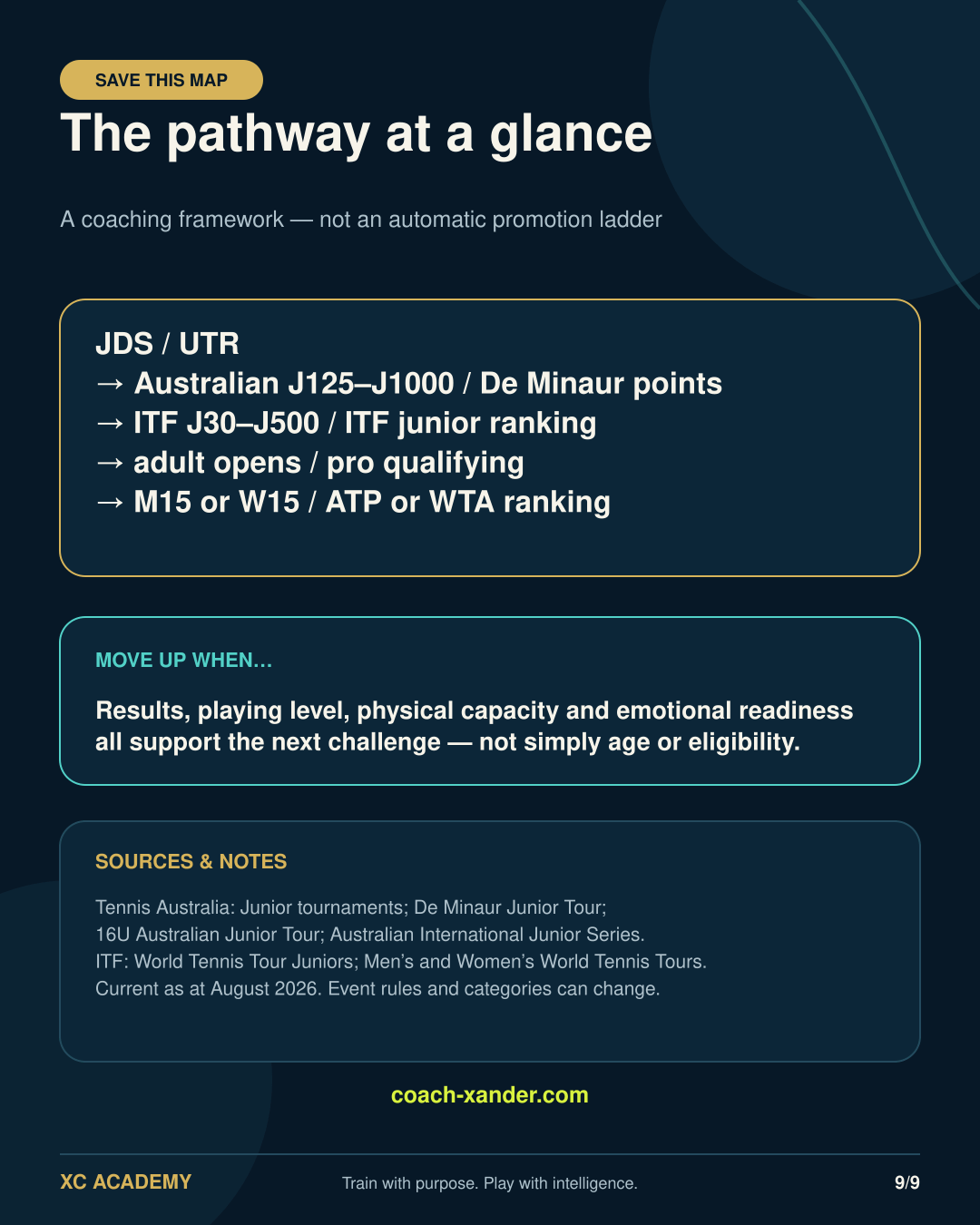
The complete pathway at a glance
For many developing Australian players, a practical route may look like this:
JDS and UTR development
→ Australian J125–J1000 events and De Minaur Junior Tour points
→ ITF J30–J500 events and an ITF junior ranking
→ adult open events and selected professional qualifying
→ M15/W15 and an ATP or WTA ranking
The route is rarely perfectly linear. A player may continue entering domestic events while beginning ITF juniors. They may play adult tournaments before earning a substantial ITF ranking. They may choose college tennis, take time to improve physically, or temporarily return to a lower tournament level to rebuild confidence and consolidate changes.
That flexibility is not failure. Good pathway planning is individual.
When should a player move up?
Before choosing the next tournament level, assess four areas together.
1. Results
Is the player consistently competitive at the current level? One upset win can be encouraging, but repeatable performance provides stronger evidence of readiness.
2. The game
Do the player’s technical and tactical foundations survive under greater pace and pressure? Moving up too early can turn every match into emergency tennis and encourage short-term technical compromises.
3. The body
Can the player tolerate the training volume, repeated matches, travel and recovery demands? Tournament readiness includes sleep, nutrition, strength, movement quality and injury management—not only stroke production.
4. The mind
Can the player manage uncertainty, setbacks, unfamiliar opponents and time away from home? Psychological readiness also includes independence, communication and the ability to reflect on a match without allowing one result to define their identity.
At XC Academy, this is why we take a holistic view of player development. Tennis coaching, strength and conditioning, and psychological skills should support each other rather than operate as separate projects.
Train with purpose. Play with intelligence.
Official pathway resources
- Macca’s Queensland Junior Development Series
- Tennis Australia: De Minaur Junior Tour
- Tennis Australia: Australian International Junior Series
- ITF World Tennis Tour Juniors
- Tennis Australia: Australian Progress Series
Tournament structures, qualification periods and acceptance rules can change. Always check the current Tennis Australia and ITF regulations before entering events or planning a competition schedule.